
Emergency vs Express vs Standard: Which Delivery Speed Should Your Business Choose?
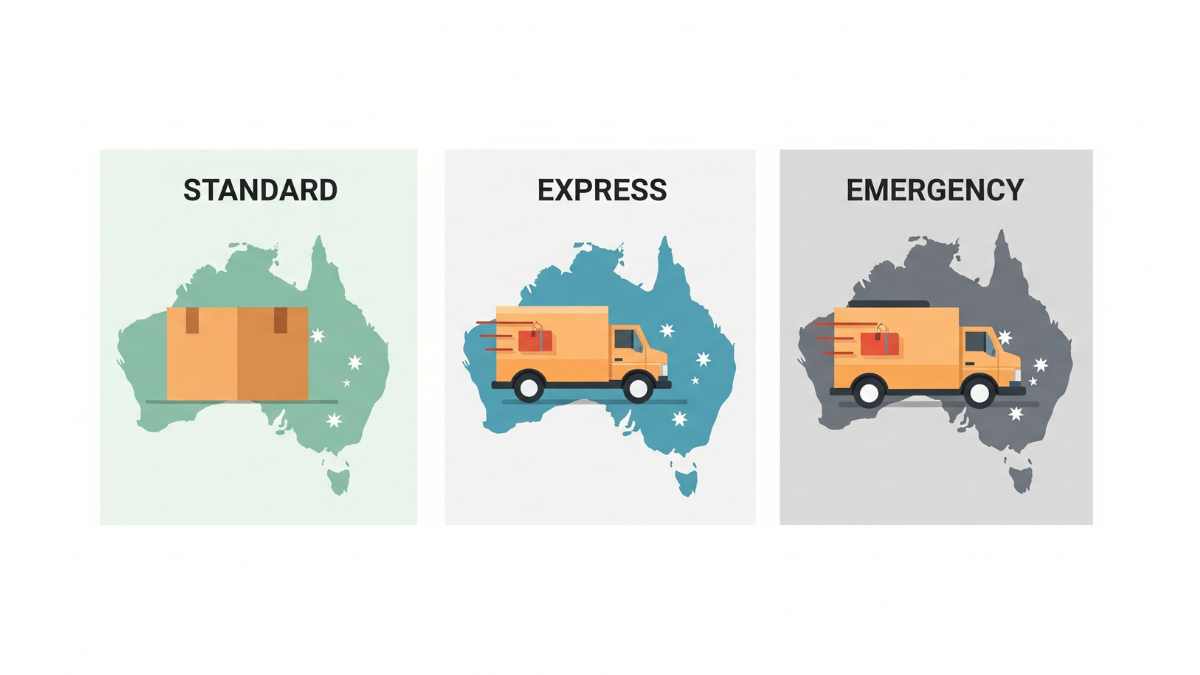
Delivery speed plays a direct role in how customers perceive your brand. If you’re a retailer in Sydney or Brisbane offering same-day delivery, the speed you choose is part of the promise you make.
Steve Orenstein talks about this in his book Delivery when he observes that customers don’t separate the product from the way it arrives. To them, it’s one experience. Get the speed and communication right, and you’re building trust.
A recent survey in July 2025 asked Australian online shoppers about their spending habits, and over 70% would recommend a brand based solely on the delivery experience. Two-thirds now view real-time tracking as essential, rather than a nice-to-have.
What Standard, Express, and Emergency Really Mean
Let’s translate the jargon into how it actually plays out on the ground in Australia.
Standard delivery
Standard is your slow-and-steady option. It’s nice because what you see is what you get. Between three and seven business days, you’ll have your items. The price is also fair and you won’t find any surprises here.
Parcels get consolidated into larger runs and shipped through ground or national parcel networks.
It’s perfect for restocking inventory, non-urgent items, or bulk orders going from your Melbourne warehouse out to regional New South Wales.
Express delivery
Express delivery is where speed and customer experience start to shape behaviour. You can expect delivery within one to three business days, with next-day or even same-day options available in major metropolitan areas, including Sydney, Melbourne, and Brisbane.
This is where shoppers pay a bit more because they have a specific date in mind, such as an event, a launch, a gift, or a part that can’t sit in transit for a week. Tracking tends to be more accurate, communication is clearer, and customers feel like their order has been pulled out of the “pile” and given some priority.
Emergency delivery
Emergency delivery lives in a different category altogether. Here we’re talking hours, not days.
A three-hour rush across Brisbane, a direct drive between two sites in Perth, or a next-flight job from Sydney to Adelaide.
These runs are designed for situations where a delay has visible consequences: a clinic cancelling appointments, a production line sitting idle, or a settlement that can’t go through because paperwork is in the wrong location.
None of these speeds is “right” or “wrong” on its own. They each make sense in specific moments. The trick is knowing which one belongs with which job.

Standard: Your Workhorse for Non-Urgent Orders
Standard shipping is your “slow and steady” option. Customers don’t mind waiting for these items. It’s not work or school supplies, or any kitchen tool that’s urgently needed. And the replacement parts that aren’t urgent, as long as they arrive this week.
Because these orders are bundled together and moved in bulk, Standard is cheap and easy to scale when volumes spike – especially in busy months like December.
The trade-off is that it won’t impress someone who needs a dress for Saturday and only sees “3-7 business days” at checkout. If Standard is the only choice you offer, those customers will click away and buy from a brand that gives them a faster option, even at a higher price.
Express: The Everyday ‘Fast Enough’
Express sits in the middle and, for most online brands, ends up doing the heavy lifting in terms of customer satisfaction.
A fashion brand in Richmond might promise next-day delivery to most Melbourne postcodes and two-day delivery to Adelaide and Sydney. A parts supplier in Western Sydney might ship express to field techs around NSW to keep equipment running. In both cases, the package isn’t “emergency”, but it absolutely isn’t casual either.
From a customer’s point of view, this is the “I can plan around it” tier. They’ve got a time frame they can trust, decent tracking, and the feeling that their order isn’t at the bottom of the pile.
From your side, Express is where you can charge a sensible premium, meet expectations most of the time, and still keep costs under control.
Locate2u’s survey found that just under half of Australian shoppers are willing to accept an all-day window as long as tracking is live and accurate. This is exactly where Express shines: they don’t need you to promise a specific time; they need to see the driver moving and the ETA updating in real-time.
Emergency: For the Jobs That Can’t Wait
Emergency delivery is the “we fix this today, or we wear the cost” bucket.
Imagine a clinic in Brisbane that discovers a critical device has failed mid-morning. Waiting for a next-day Express run from Sydney means cancelling a full afternoon of appointments. An emergency three-hour courier can collect the replacement from a local distributor and get it there before the first patient even reaches the waiting room.
Or picture a property settlement in Adelaide where the original signed paperwork is sitting on a partner’s desk in Melbourne. Scans won’t cut it, and the settlement time is locked.
An emergency courier run linked to a next-flight service can be the difference between a smooth settlement and a wave of phone calls, penalties, and rescheduling.
This is why Orenstein talks about understanding the “real cost of late” in Delivery. Sometimes the freight bill feels high in isolation, but tiny compared to the revenue, reputation, or legal risk that’s on the line if you miss the window.
Emergency speeds shouldn’t be your default for every order. They’re the red button you press when the delay is more expensive than the delivery fee.
How to Decide: A Simple Way to Match Speed to the Job
You don’t need a huge matrix on the wall. A few clear questions usually point you to the right service:
- If a delay of a few hours genuinely breaks something, like a deadline, a procedure list, or a job site, you’re in Emergency territory.
- If the customer cares about “this week” or “by the weekend” rather than “by 3pm today”, Express will generally keep them happy.
- If nobody’s watching the clock and price is the main concern, Standard is perfectly fine.
There are two additional checks to follow: the value or fragility of the item, and the promises you’ve made publicly.
High-value or sensitive freight typically falls under Express or Emergency categories, primarily because the handling, tracking, and proof-of-delivery standards are higher.
And if your website or sales team has promised “same-day delivery in Sydney”, you need to back that up with a speed tier that actually delivers on it.
Where Zoom2u Fits In
This is where a platform like Zoom2u makes life simpler. Instead of juggling three different providers for three different speeds, you can work with one network that lets you dial up or down depending on the job.
If you need same-day or three-hour delivery in Sydney, Melbourne, Brisbane, Perth, Adelaide or Canberra, you can book Emergency-style runs and watch the courier move in real time.
For next-day or “fast but not frantic” jobs, you can use Zoom2u’s next-day options and still give customers tracking and ETAs. All of it runs seven days a week, with no weekend “surprise” fees when someone inevitably orders late on a Saturday.
Behind that, tools like Locate2u help you bring the same discipline to your own fleet.
Route optimisation, live tracking, and proof-of-delivery aren’t just for the big guys anymore. They’re how smaller teams in places like the Gold Coast or outer Melbourne can keep promises without spending every morning buried in a whiteboard of runs.